
The Cowboy They Built

On the night of June 3rd, 1876, one hundred and fifty years ago, the curtain came down at the Grand Opera House in Wilmington, Delaware, and Texas Jack Omohundro and Buffalo Bill Cody walked offstage together for the last time.

There was no announcement that this was an ending. No reviewer marked it. The two men had stood on stages together for four years, played hundreds of shows from Maine to Texas, and turned themselves from a scout and a cowboy into what Cody called "first-class stars." That June night looked like any other stop on a long tour. But Cody's five-year-old son, Kit Carson Cody, had died of scarlet fever six weeks earlier, and the grief had hollowed out whatever appetite Bill still had for greasepaint and footlights. He had confided to his friend that he just couldn't keep doing it. Jack understood. They dissolved the joint combination. Before the summer was up both men were back in the saddle as army scouts, drawn west again by the news from the Little Bighorn.
They parted as friends, and remained friends until Jack's death four years later. Cody mourned him for the rest of his long life. But they never again stood on a stage together. In the forty years between that show in Wilmington and Cody's death in 1917, no man would ever again share a stage or an arena with Buffalo Bill as an equal. Cody himself wrote the line that fits best: they were "Pards of the Plains for Life."

That much I've written before. What I keep coming back to, a century and a half on, is not the ending itself but what the partnership had already done by the time it ended. Because in those four years between a notoriously shaky Chicago debut and a Wilmington farewell, two men who could barely act invented something that outlived both of them, outlived the frontier they came from, and is still with us every time a figure in a hat rides across a screen. They invented the western. They invented The Cowboy.
Before the stage
It is worth remembering that in 1872 the cowboy was not a hero. He was a laborer.
The word described a young man, very often a poor one, who did hard and dangerous seasonal work moving cattle north out of Texas. He was dusty, broke, frequently looked down upon, and entirely absent from the national imagination. There were no cowboy novels worth the name, no cowboy songs in the parlor, no cowboy on the stage. The men who captured the public's fascination in the years after the Civil War were scouts and gunfighters and soldiers. Men like Wild Bill Hickok, the cavalry officers of the Indian Wars, and hunters. The cowboy was the man who did the work nobody wrote about.
John Baker Omohundro was, improbably, all of these things at once. Born in Virginia in 1846, he rode as a scout and courier for J.E.B. Stuart's Confederate cavalry during the war. When it was over, he went to Texas, became a cowboy and then a trail boss, and drove longhorns up the Chisholm and Goodnight-Loving trails. On a drive into Tennessee, someone called him "Texas Jack," and the name stuck to the Virginian for good. He met Wild Bill Hickok in Kansas and Buffalo Bill Cody in Nebraska, hired on as a civilian scout for the Fifth Cavalry, and earned a reputation as one of the best trackers and marksmen on the plains.

In other words, the man who would put the cowboy on the stage had personally been the cowboy, the soldier, and the scout. He had lived all the roles the public already admired and the one it had overlooked. When Ned Buntline pulled Cody and Omohundro into a Chicago theater in December of 1872 for The Scouts of the Prairie, the two were billed as scouts, because that was the thing audiences came to see. But Texas Jack brought the cowboy in the door with him, put him on the stage, and the cowboy never left.
What they made in four years
They were not good actors. Everyone said so, including them. The reviews of that first Chicago night were merciless about the bad acting and rapturous about the real heroes, and that gap — bad actors, irresistible figures — turned out to be the whole point. Audiences weren't coming for a play. They were coming to be in a room with men who had actually done the things the dime novels described, and the theater gave them a way to sell their authenticity night after night.
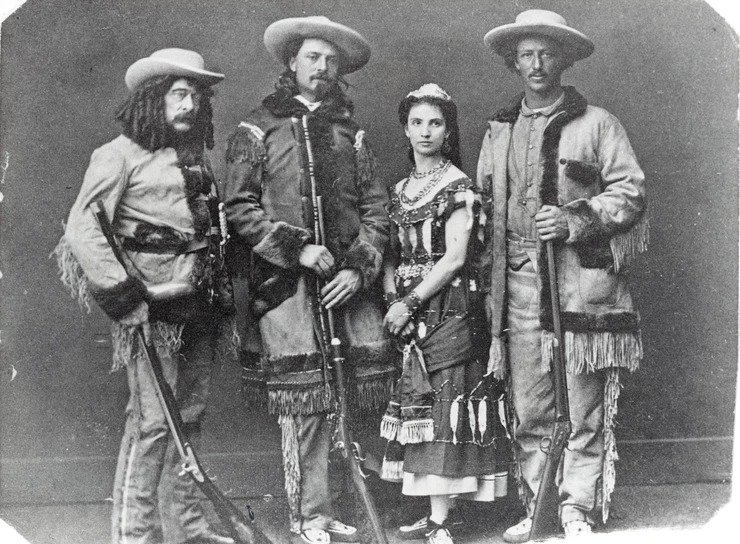
What Texas Jack added was a vocabulary. He is generally credited as the first man to perform cowboy rope tricks on a stage, turning a working skill — the lasso, the daily tool of his old trade — into spectacle. He brought the horse onto the stage in a way no one had managed before; one New York critic admitted that the horse had always been a failure on stage until Texas Jack handled it, and another wrote that watching him work a horse on the boards was worth double the price of admission. Roping, riding, marksmanship, the easy southern drawl, the buckskin, the practiced competence: piece by piece, across four years and hundreds of performances, the partnership assembled the grammar of how a cowboy looks and moves and behaves in front of an audience.
And they did it as a true partnership. They split the money equally, made decisions together, and traded top billing city by city. Cody's name first up north where the Union veteran drew the crowd, Jack's was first in the South where audiences wanted to see the Confederate scout. That detail matters more than it looks. A Yankee soldier and a Rebel cavalryman standing shoulder to shoulder, equal partners, eleven years after Appomattox, was its own kind of argument. To northern crowds it said the southern man was as capable as anyone; to southern crowds it said friendship across the old divide was possible. West of the Mississippi, where their story was set, the Mason-Dixon line did not exist. The Cowboy was, from the very beginning, a figure who stood outside the country's deepest wound. And that may be part of why the whole nation could claim him.
By the time they reached Wilmington in June of 1876, the work was essentially done. The template existed. It just didn't have anyone left to carry it at scale.

The four years alone, and the forty years after
When the partnership ended, Texas Jack didn't stop. For a long time historians assumed his career more or less trailed off after 1876, but the newspaper record tells a different story: between that Wilmington farewell and his last known performance in Leadville in 1880, Jack staged hundreds of his own shows. His combination drew crowds and reviews that rivaled anything Cody was doing, and when it premiered in Chicago, eleven generals turned out to watch, an implicit endorsement that rang out across the newspapers.
Look closely at who Texas Jack surrounded himself with in those years, and you are looking at every element of the Wild West show, already assembled, years before there was a Buffalo Bill's Wild West. Jack brought the Warm Springs scout Donald McKay onto the stage with him, a genuine Native frontier figure, and a famous one from his service during the Modoc War, alongside his daughter Minnie, who became a draw in her own right. That was 1876, nearly a decade before Sitting Bull and a company of Lakota would travel with Cody.

Jack hired Maud Oswald, a trick rider from P.T. Barnum's Hippodrome, to perform feats of horsemanship for his audiences, years before Annie Oakley made the celebrated woman performer a fixture of the Wild West.
And in the summer and fall of 1878, Jack teamed with the marksman Doc Carver for a string of open-air exhibitions up and down the East Coast, timed to coincide with state fairs and local gatherings: shooting, riding, roping, staged not in a theater but outdoors before huge crowds. Five years before Cody opened the first Wild West, these were a working test of the whole format.

The point is not that Texas Jack invented Buffalo Bill's Wild West. He didn't. But every piece of it — the co-starring Native warrior, the woman performer, the outdoor arena of marksmanship and horsemanship and rope work, the military men in the seats lending it the authority of the real — was present in his endeavors first, and was then gathered up, codified, and mosaiced together into a single enormous spectacle by men who had stood beside him while he was working it out.
Doc Carver makes the lineage almost embarrassingly literal: the man loading Jack's rifles at those 1878 exhibitions was the same W.F. Carver who, in 1883, co-founded the first Wild West with Buffalo Bill Cody. Jack drew the blueprint. He simply didn't live to see the cathedral built from it.
He died of tuberculosis and pneumonia in Leadville in 1880, a month shy of thirty-four. It was a quiet death, the kind that doesn't echo. There was no assassin, no Deadwood, nothing for the dime novels to seize on, and so the man who had invented the stage cowboy began to fade almost immediately from the story he had started.

Cody did not fade. In 1883 he launched Buffalo Bill's Wild West, and over the next thirty-four years he took it across America and then across an ocean, performing for crowds of thousands and for the crowned heads of Europe. He folded in Lakota warriors, Mexican vaqueros, Russian Cossacks, riders from around the world. But the beating heart of the Wild West, the moment the audience waited for, was always the arrival of the cowboys, galloping in to rescue the besieged settler's cabin. It almost never happened that way; cowboys and Native people rarely came to blows. But it was not conjured out of nothing. Once, in April of 1872, months before either man had set foot on a stage, Cody and Texas Jack rode out of Fort McPherson after a band of Miniconjou Sioux who had run off horses from a railroad station.
In the fight that followed, a warrior leveled his rifle at Cody at close range; Jack caught the glint of the barrel and fired first, and the bullet that should have killed Buffalo Bill only grazed his scalp. The cowboy had saved the scout from an Indian under fire. That afternoon on the Loup Fork is the seed of the whole thing: Cody would spend the rest of his life magnifying that one real moment into a spectacle he sold around the world, and beneath all of it, the cowboy riding to the rescue was Texas Jack. He was not showing the West as it was. He was showing the West as Texas Jack had taught audiences to want it, and he broadcast that vision to more people, in more countries, than any frontier figure before or since.

The cowboy, who began as a menial laborer on the dusty trails of Texas, was assembled into a hero on stage by Omohundro between 1872 and 1880, and was carried to the world by Cody between 1883 and 1917, had become, by the time Buffalo Bill died, the central figure of how America imagined itself.
Every cowboy since
Here is the part that should be strange and somehow isn't. The cowboy never went away. The man faded, the show closed, the frontier was fenced and paved. But the figure they built only got bigger.
When the movies arrived, the cowboy was waiting for them, fully formed. The earliest narrative film most people can name, The Great Train Robbery, was a Western, made in 1903 while Cody was still touring. The first true movie star to be marketed as a star, Broncho Billy Anderson, was a cowboy. Tom Mix and William S. Hart built the silent Western; John Wayne and the studio system industrialized it; the singing cowboys put it on the radio and the cereal box; television filled the 1950s and '60s with so many men in hats that for a stretch the Western was simply what American entertainment was. The genre crested, broke, was declared dead more than once, and kept coming back. Eastwood's drifters, the revisionist Westerns that tried to tell the harder truth, Lonesome Dove, Unforgiven, the Coens, and now a streaming landscape where Yellowstone and its sprawl of spin-offs have made the cowboy, improbably, one of the most-watched figures on television in the 2020s.

And it isn't only the screen. The cowboy is American shorthand now, a piece of visual language understood everywhere on earth. He sells trucks and jeans and cigarettes. He stands in for self-reliance, for the frontier, for a particular idea of American manhood that politicians borrow and advertisers rent. Strip a costume down to a hat and boots and a certain way of standing, and people on the far side of the planet know exactly what you mean. That legibility, that the cowboy reads instantly as the cowboy, isn't natural. It's learned. It was taught. And the first teachers were two men who couldn't act, working out the grammar of it on a stage in the 1870s.
Pull the thread on any of it, John Wayne, Clint Eastwood, the Marlboro Man, Kevin Costner on a Montana ranch, and it runs back through Cody's arena to a Wilmington stage on the third of June, 1876, and to the four years before it. The cowboy on your screen is standing on the broad shoulders of Texas Jack.

Curtain call
So when I think about that final show now, a hundred and fifty years later, I don't think of it as the night a friendship's stage partnership ended, though it was that. I think of it as the night the work was finished. The thing had been made. Two men had taken a dusty, disregarded occupation and four overlapping identities — cowboy, soldier, scout, showman — and fused them into a single figure durable enough to outlast themselves and the West itself.
Texas Jack would carry it alone for four more years and then die young and largely forgotten. Buffalo Bill would carry it for forty more and become the most famous American on earth. But the thing they were carrying, they built together, and it was essentially complete by the time the curtain fell in Wilmington. Everything that came after, the Wild West, the dime novels, the films, the television, the hat that means one thing in every language, is just the long echo of a story those two men told on the stage together.
Buffalo Bill said that he and Texas Jack were "Pards of the Plains for life." And, as it turns out, the architects of an American icon that has outlived their partnership by more than a century and a half, and shows no sign of riding off into any sunset.
If you'd like to learn more about Texas Jack Omohundro and his adventures with Buffalo Bill Cody and Wild Bill Hickok — and how these men turned their real-life exploits into the Westerns we all know and love — the full story is in Texas Jack: America's First Cowboy Star.

Comments